
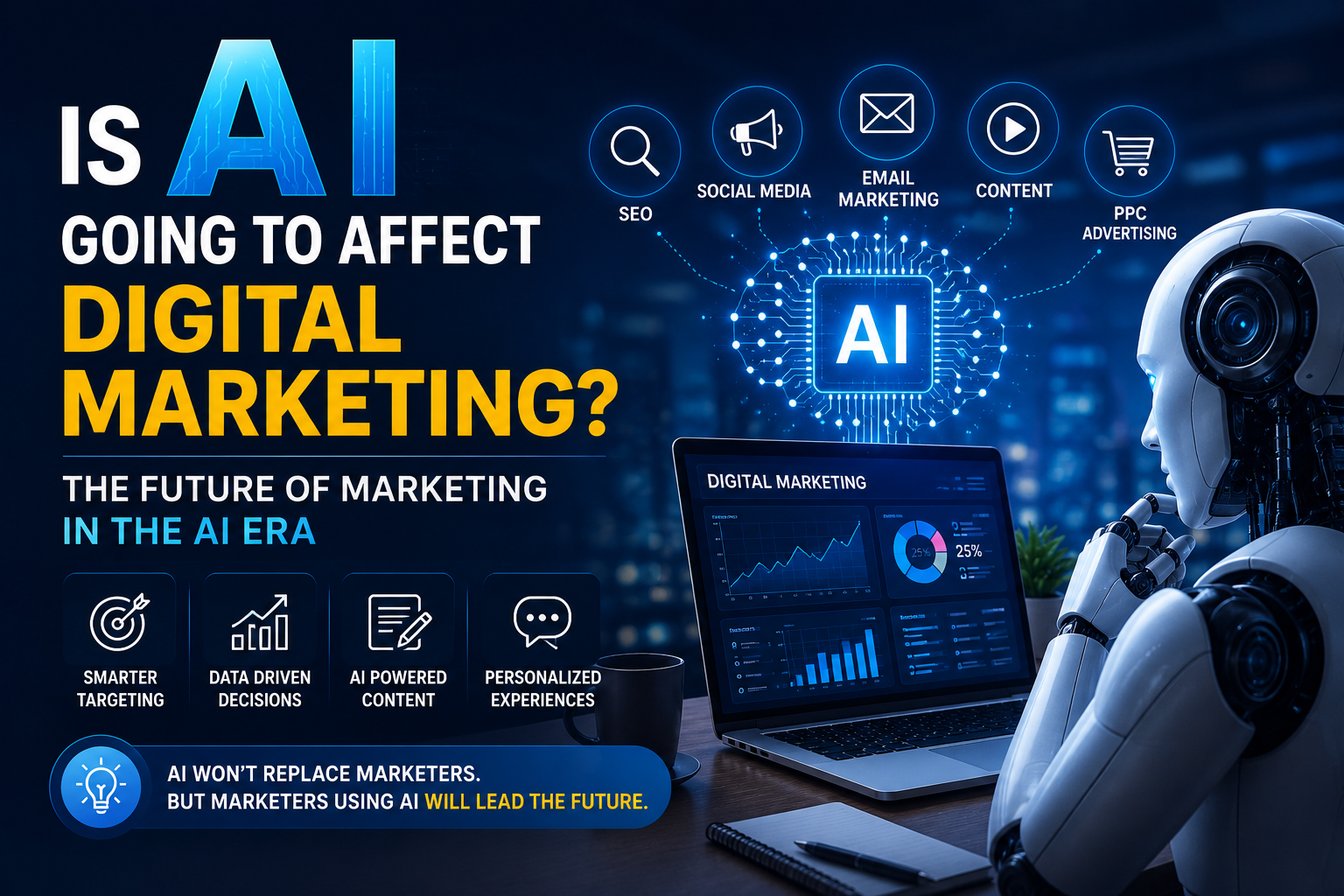
Picture a Monday morning at a small marketing agency. Before the first cup of tea, a junior executive has asked an AI tool for ten ad headlines, a draft email sequence and a summary of last week’s campaign report. By ten o’clock, the groundwork is done. So what is left for the human?
Quite a lot. AI in digital marketing is already changing how the work gets done, but it is changing the job far more than it is ending it. AI is taking over repetitive tasks such as first drafts, data crunching and bid adjustments. Strategy, creativity, judgement and client trust still need people. The marketers at risk are those who refuse to learn the tools, not those who use them well.
What Is the Role of AI in Digital Marketing?
Table of Contents
ToggleIn simple terms, artificial intelligence in marketing means software that learns from data and then does work that once needed a person’s time. It spots patterns, predicts what a customer might do next, and creates text, images or reports when you ask for them.
You have probably used it without calling it AI. Gmail suggests replies. Google Ads suggests keywords and adjusts bids. Canva removes an image background in one click. Your analytics tool flags a sudden traffic drop before you open a single report. Generative tools such as ChatGPT, Gemini and Claude add something new: you can brief them in plain language and get a draft back in seconds.
AI is brilliant at speed and scale. What it does not have is your business context. It does not know your customers’ local habits, your brand promises or what your client said on last Tuesday’s call, unless a person tells it.
How Is AI Changing the Digital Marketing Industry?
The impact of AI on digital marketing is not the same everywhere. Some channels have changed a lot, others only a little. Here is how it looks channel by channel.
AI in SEO
Search itself now has AI built in. Google’s AI Overviews and AI Mode can pull together answers from several sources, and they use a technique Google calls query fan-out, which runs multiple related searches behind the scenes. For site owners, Google’s own guidance is reassuring and a little boring: there are no extra requirements or special tricks to appear in these features, and the normal SEO fundamentals still apply.
That means helpful, original content, pages that can be crawled and indexed, and a good experience on the page. If you are new to the basics, our guide on what SEO is is a good place to start. AI in SEO helps behind the scenes too: clustering keywords, drafting content briefs, finding technical issues and spotting content gaps. It speeds up research. It does not replace the judgement about what your audience really needs.
AI in Google Ads and PPC
Paid search has been automated for years, and the pace is picking up. Google’s AI Max for Search campaigns is a set of AI features switched on inside an existing Search campaign. It can match your ads to relevant searches beyond your keyword list, generate ad text and choose landing pages. Performance Max is different. It is a separate campaign type that runs across Google’s channels, not just Search.
Google and some agencies publish impressive uplift figures for these tools. Treat them as vendor claims. Test on a small budget, compare against your current campaigns and check the search terms report. The marketer’s job moves towards the things the machine cannot fix: accurate conversion tracking, sensible budgets, negative keywords, strong creative and landing pages that convert.
AI in Social Media Marketing
On social platforms, AI is most useful for volume work. It can suggest caption variations, turn one long video into several short clips, summarise comments and flag which posts are working. What it cannot do is sense the mood of a community or know when a joke will land badly. Brand voice, timing and real conversations still belong to people.
AI in Content Marketing
AI in content marketing is where most beginners start. It is good for outlines, first drafts, repurposing a blog into an email or a script, and tidying rough writing. The catch is sameness. If everyone asks the same tool for the same article, everyone publishes the same article. Original examples, local knowledge and real experience are what make content worth reading, and what Google’s quality guidance keeps rewarding.
AI in Email Marketing
Email tools can test several subject lines, pick better send times and segment lists by behaviour. A shop can send a different follow-up to someone who abandoned a cart than to someone who just bought. The offer, the promise and the tone still need a human who understands the customer.
AI in Customer Behaviour Analysis
This is where AI quietly earns its keep. It can group customers by behaviour, score leads by how likely they are to buy, and predict who might stop buying. Platforms like Google Analytics include automated insights and predictive features, though what is available depends on your setup and data volume. Good analysis still starts with good tracking, and no tool can fix a messy setup.
AI Marketing Automation
Marketing automation used to mean fixed rules: if someone downloads the guide, send email two. AI marketing automation adds decisions on top of that. HubSpot’s Breeze, for example, bundles an assistant, agents and data-enrichment features into its CRM, with the more advanced agents sitting in higher-priced plans. The sensible approach is to automate one repeatable workflow, check the output closely, and only then scale it.
Two practical examples (hypothetical)
These are illustrative scenarios, not real case studies or results.
Example 1: a local furniture store. The owner wants more enquiries from nearby customers. She uses an AI assistant to cluster keyword ideas such as “sofa repair near me” and “custom wardrobe designs”, and to draft three outlines. Her marketer picks the topics, adds photos of real projects, local pricing and customer questions from the showroom, and publishes. The AI saved research time. The photos and local knowledge made the pages trustworthy.
Example 2: a small online course seller. A Search campaign is running with a short keyword list. The marketer tests AI Max on one campaign with a limited budget. In the first two weeks she reviews the search terms report daily, adds negative keywords for irrelevant queries and rewrites weak ad copy. The automation widened the reach. Her review kept the quality up.
Traditional vs AI-Powered Digital Marketing
| Area | Traditional approach | AI-powered approach |
|---|---|---|
| Keyword research | Manual lists and spreadsheets | AI clusters topics and suggests gaps; human picks priorities |
| Content creation | Written from scratch | AI drafts and outlines; human adds experience and edits |
| Ad management | Manual bids and keyword matching | Automated bidding and query matching; human guards quality |
| Reporting | Hours building dashboards | Automated summaries and anomaly alerts |
| Personalisation | Broad segments | Behaviour-based messages at scale |
| Speed | Days for a campaign draft | Hours, with more review needed |
Will AI Replace Digital Marketers?
Honest answer: it will replace some tasks, and it will probably reshape some roles. It is unlikely to replace the need for marketers who think.
What AI can already automate: keyword grouping, first-draft copy, subject line testing, bid adjustments, report summaries, image resizing and basic social scheduling.
What still needs a human: deciding which customers to target and why, judging whether a message fits the brand, negotiating with clients, reading a market that data has not caught up with yet, and taking responsibility when something goes wrong. Creativity matters here too. AI can remix what exists. A good marketer notices what is missing.
The World Economic Forum’s Future of Jobs Report 2025 lists AI and big data as the fastest-growing skills through 2030, alongside creative thinking, resilience and flexibility. That is a useful hint for marketers: learn the technology, and keep sharpening the human skills around it.
One caution. Entry-level tasks such as basic copywriting and routine reporting are the most exposed, so beginners need to show more than tool skills. Strategy, results and real projects set you apart. If you are weighing the career itself, read is digital marketing a good career.
Benefits of AI in Digital Marketing
Used well, the benefits of AI in digital marketing are practical, not magical.
- Time savings and productivity: a content brief that took an hour can take fifteen minutes, which frees time for thinking.
- Personalisation: different messages for new visitors, returning customers and lapsed buyers, without writing every version by hand.
- Data-driven decisions: AI can surface patterns in campaign data that a busy person would miss.
- Better customer experience: faster answers through chatbots and more relevant recommendations.
- Campaign optimisation: constant testing of headlines, audiences and send times.
The pattern is the same each time. AI handles the volume, and the marketer decides what is worth doing.
Challenges of Using AI in Digital Marketing
The risks are real, and ignoring them is how brands end up embarrassed.
Wrong information. AI tools can state false things confidently, including made-up statistics and sources. Check every number and claim before publishing.
Data privacy. Pasting customer lists or confidential client data into a public tool can break privacy rules and client trust. Know your tool’s data policy and your local law before you upload anything.
Lack of originality. AI works from patterns in existing material. Without your own experience, examples and opinions, content turns generic fast.
Over-dependence. Marketers who let the tool think for them lose the skill of judging quality. Use it as an assistant, not as the decision-maker.
Limits of creativity. AI can generate a hundred ideas, but it does not understand why one will move a particular audience.
Search quality. Publishing large amounts of thin, mass-produced pages is a poor strategy. Google’s guidance keeps pointing to helpful, people-first content, and it stays a moving target, so check the official documentation regularly.
Top AI Tools Every Digital Marketer Should Know
Features, limits and pricing change quickly, so confirm details on each vendor’s website before you commit.
| Tool | What it does | Practical marketing use |
|---|---|---|
| ChatGPT | General-purpose AI assistant | Brainstorming angles, drafting emails, summarising research |
| Gemini | Google’s AI assistant | Research support and drafting, especially if you work in Google’s apps |
| Claude | General-purpose AI assistant | Editing long drafts, analysing pasted reports, rewriting in a given tone |
| Canva AI | AI features inside Canva’s design tools | Quick social graphics, resizing, simple image edits |
| Semrush | SEO and competitor research suite with AI features | Keyword research, competitor gaps, content ideas |
| Surfer SEO | Content optimisation tool | Checking a draft against what top-ranking pages cover |
| HubSpot AI (Breeze) | AI layer across HubSpot’s CRM and marketing tools | Email drafts, content help, automation and lead workflows |
| Google Analytics | Website and app analytics with automated insights | Spotting traffic changes and understanding which channels convert |
A tip from the desk: pick two tools, not eight. Learn one assistant and one analytics or SEO tool properly. Depth beats a long list of logins.
What Skills Should Digital Marketers Learn in the AI Era?
The skills digital marketers need in the AI era are a mix of the technical and the human.
- SEO and AI-powered search: understand search intent, technical basics and how AI answers change clicks.
- Google Ads and Meta Ads: learn campaign structure, tracking and budgets so you can guide automation instead of obeying it.
- Content strategy: know what to publish, for whom and why.
- Data analytics: read reports, question numbers and explain results to a client.
- Prompt engineering: give clear context, constraints and examples to get usable output.
- Marketing automation: build and test simple workflows.
- Strategic thinking, creativity and communication: the skills that make advice worth paying for.
What Is the Future of Digital Marketing?
Nobody can predict it precisely, and anyone who claims to is guessing. Still, some directions are clear enough to plan around.
Search is becoming more conversational, with AI-generated answers sitting alongside classic results. Google says clicks from pages with AI Overviews tend to be higher quality, though results vary by site and query, so watch your own Search Console data. Customers will also expect faster, more personal replies. New roles are appearing around AI workflows, content quality control, marketing analytics and automation.
The one constant is continuous learning. The tool you master this year may look different in twelve months. The habit of testing, measuring and adapting will not go out of date.
How Can Beginners Build a Career in Digital Marketing?
You do not need a perfect plan. You need steady practice. Here is a realistic roadmap.
- Learn the fundamentals (weeks 1 to 4). Understand how SEO, paid ads, social media, email and analytics fit together. Our explainer on what digital marketing is covers the basics.
- Pick one core channel (weeks 4 to 8). SEO, Google Ads or social media. Go deep before you go wide.
- Add one AI assistant and one analytics tool (weeks 6 to 10). Practise real tasks: outlines, ad variations, a simple report.
- Build a live project (weeks 8 to 16). Start a small blog, a local business page or a practice ad account with a tiny budget. Track real numbers.
- Document your results. Keep a simple portfolio showing what you did, what changed and what you learned. Be honest about the numbers.
- Apply, intern or freelance. Start with small local businesses, and keep learning while you earn.
If you are still deciding where to begin, this digital marketing course for beginners guide can help.
Conclusion
AI is not a passing trend in digital marketing, and it is not a robot waiting to take your seat. It is a powerful tool that rewards people who understand marketing first and the software second. The marketers who will do well are those who test tools carefully, check the output, protect customer data and keep building the human skills machines lack.
Your next step is simple. Pick one channel, learn it properly, and practise with one AI tool on a real project this month. If you want guided, hands-on training instead of figuring it out alone, explore a practical digital marketing course that covers SEO, Google Ads, social media and AI tools together.
Frequently Asked Questions
Is AI going to replace digital marketers?
AI will automate many routine tasks, such as drafting, reporting and bid changes, but it is unlikely to replace marketers who bring strategy, creativity and judgement. Roles will change. Marketers who learn to work with AI tools will be in a stronger position than those who avoid them.
Does digital marketing have a future with AI?
Yes. Businesses still need customers, and someone has to decide who to reach, what to say and how to measure results. AI changes how the work is done and raises expectations for speed and quality, so the field is evolving rather than disappearing.
How is AI used in digital marketing?
AI is used for keyword research, content drafts, ad bidding and matching, email personalisation, social media captions, customer segmentation, lead scoring and reporting. In most good workflows, AI produces a first pass and a human reviews, corrects and approves it.
Which AI tools are useful for digital marketers?
Popular options include ChatGPT, Gemini and Claude for writing and research, Canva for design, Semrush and Surfer SEO for search work, HubSpot for automation and Google Analytics for data. Start with one assistant and one analytics or SEO tool.
Can beginners learn digital marketing in the AI era?
Yes. AI tools actually lower the barrier to practising, because you can test ideas faster. Beginners should still learn the fundamentals first, build a small live project and show real results. Tool skills alone will not stand out.
Will AI replace SEO professionals?
Unlikely. AI speeds up research and drafting, but SEO also involves understanding search intent, technical fixes, site strategy and business goals. Google’s guidance says the fundamentals still apply to AI search features, so skilled SEO professionals remain valuable.
What digital marketing skills will be in demand?
Expect demand for SEO, paid media, content strategy, data analytics, marketing automation and AI tool skills, along with communication and critical thinking. Employers value people who can explain results and make decisions, not just operate software.
Is digital marketing a good career choice in 2027?
It can be, if you are willing to keep learning. Demand depends on skills, location and the quality of your work. Choose a channel, practise on real projects and stay current. Nobody can guarantee outcomes, so build proof of your results.
Editorial note: Statements about Google’s AI search features, Google Ads AI Max, HubSpot Breeze and the World Economic Forum report were checked against public sources on 30 October 2026. Tool features and pricing change often, so please confirm details on each vendor’s website. The two campaign examples above are hypothetical illustrations, not real client results.
Sources and further reading: Google Search Central: AI features and your website, Google Ads Help: AI Max for Search campaigns, World Economic Forum: Future of Jobs Report 2025.

1 thought on “Is AI Going to Affect Digital Marketing? The Future of Marketing in the AI Era”