
Last updated: November 4, 2026
The 4 Ps of marketing are product, price, place and promotion. Together they are called the marketing mix: four decisions a business controls to meet customer needs and sell what it offers.
In this guide, you will learn what each P means, see simple examples, follow a step-by-step way to use the 4 Ps, and understand how they compare with the 7 Ps and the 4 Cs. The examples are made up for illustration. The history is checked against the original sources listed at the end.
What Are the 4 Ps of Marketing?
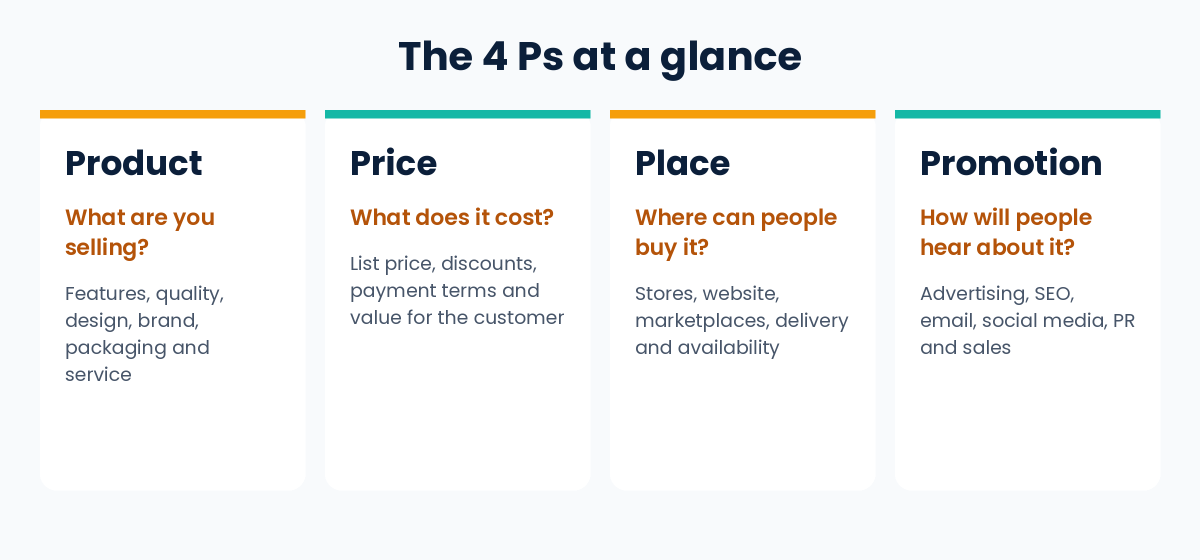
The 4 Ps are a checklist for planning how you take a product or service to market. Each P answers one simple question:
| The P | The question it answers | Typical decisions |
|---|---|---|
| Product | What are you selling? | Features, quality, design, brand, packaging, service |
| Price | What does it cost the customer? | List price, discounts, payment terms |
| Place | Where and how can people buy it? | Stores, website, marketplaces, delivery, availability |
| Promotion | How will people hear about it? | Advertising, SEO, email, social media, PR, sales |
These are things a business can control, which is why the framework is called the marketing mix. You can change your product, price, place and promotion. You cannot directly control what customers think or what the economy does.
Where the 4 Ps Come From
- Harvard professor Neil Borden popularized the term “marketing mix”. He said he had used the term since the late 1940s, spoke about it in a 1953 American Marketing Association address, and published “The Concept of the Marketing Mix” in 1964, which made the idea widely known. His list had at least twelve elements.
- E. Jerome McCarthy simplified the idea into four groups in his 1960 textbook Basic Marketing: A Managerial Approach. Those four groups are product, price, place and promotion.
The simple four-part version became one of the most widely taught frameworks in marketing, because it is easy to remember and easy to apply.
1. Product: What You Sell
Your product is what you offer to solve a customer’s problem. It includes more than the item itself:
- Features and quality
- Design and brand
- Packaging
- Customer service, warranty and returns
Questions to ask: What problem does it solve? Who is it for? Why would someone choose it over the alternatives? What support do customers get after buying?
Example (made up): A neighborhood bakery sells sourdough bread and custom cakes. Its product is not just the bread. It is the taste, the freshness, the packaging and the friendly service.
For digital products such as software, apps and online courses, the product includes the features, how easy it is to use, and how often it improves.
2. Price: What Customers Pay
Price is the amount a customer pays. It also includes discounts, payment terms and financing options. Customers often “pay” with time and effort too, not only money. Price also sends a signal about quality, so a price that is too low can make a product look cheap.
Three common ways to set a price:
| Approach | How it works | Watch out for |
|---|---|---|
| Cost-plus | Your cost plus a markup | It ignores what customers think the product is worth |
| Competitor-based | Set your price in relation to competitors | You need a clear reason to be cheaper, equal or more expensive |
| Value-based | Set the price by the value customers see | It needs real customer research |
Whatever method you use, check that the price covers your costs and leaves a profit.
Example (made up): The bakery prices its bread a little above supermarket bread, because its ingredients cost more and customers value freshness. It offers a small discount to people who pre-order for the week.
3. Place: Where and How Customers Can Buy
Place is how your product reaches customers. It covers where people can buy it, how easy it is, and whether it is in stock when they want it. Examples include your own shop, your website, online marketplaces, app stores, distributors and delivery services.
For local businesses, being easy to find matters. Google says that keeping your Business Profile details up to date can help your business be visible in Google Search results.
Example (made up): The bakery sells in its shop, takes pre-orders through its website, and delivers locally on weekends.
4. Promotion: How People Hear About You
Promotion is every way you communicate with customers and move them toward a decision. It includes:
- Advertising, online and offline
- Content and search engine optimization (SEO)
- Email and social media
- Public relations and partnerships
- Sales promotions and personal selling
Keep your message consistent across channels, and track results so you know what works. For measurable paid campaigns, read our guide on what is performance marketing. To bring in visitors from search, see our beginner guide on what is SEO.
Promotion is the P most people think of first. A common mistake is to spend most of the effort here and neglect the other three.
Worked Example: The 4 Ps for a Neighborhood Bakery
This is a made-up example to show how the four decisions fit together.
| P | The bakery’s decision |
|---|---|
| Product | Fresh sourdough and custom cakes, made with quality ingredients |
| Price | A little above supermarket prices, with a discount for weekly pre-orders |
| Place | The shop, a pre-order page on its website, and local weekend delivery |
| Promotion | An up-to-date Google Business Profile, photos on social media, and an email list for pre-orders |
How the 4 Ps Work Together
The four Ps only work well when they point in the same direction. Here are three common mismatches:
- A premium product with constant deep discounts confuses customers about its quality.
- A great product that is hard to find or buy loses sales, however good the advertising is.
- Strong promotion for a product that does not solve a real problem brings visitors who do not buy.
The 4 Ps of Marketing in Digital Marketing
The framework is the same online. Only the examples change:
| P | Digital examples |
|---|---|
| Product | Software features, app experience, free trials, online courses |
| Price | Subscriptions, free plans, bundles, discount codes |
| Place | Your website, app stores, online marketplaces, social media shops, local listings |
| Promotion | SEO, paid ads, email, social media, content, influencer partnerships |
Digital tools such as Google Analytics make it easier to measure promotion. They do not change what the four decisions are.
How to Use the 4 Ps of Marketing, Step by Step
- Define your target customer. Who are you trying to help, and what do they need?
- Learn about customers and competitors. Use surveys, customer reviews, sales data and competitor websites.
- Shape the product around a real problem. Be able to say in one sentence why customers should choose it.
- Set a price you can defend. Consider your costs, the value to customers and competitors’ prices.
- Choose where and how people buy. Make buying as easy as you can for your target customer.
- Plan your promotion and measure it. Pick channels where your customers already spend time, and track results.
- Review all four together. Revisit them regularly, because a change in one P often affects the others.
4 Ps vs 4 Cs vs 7 Ps
| Model | Created by | Elements | Best for |
|---|---|---|---|
| 4 Ps | E. Jerome McCarthy, 1960 | Product, price, place, promotion | Planning from the seller’s side |
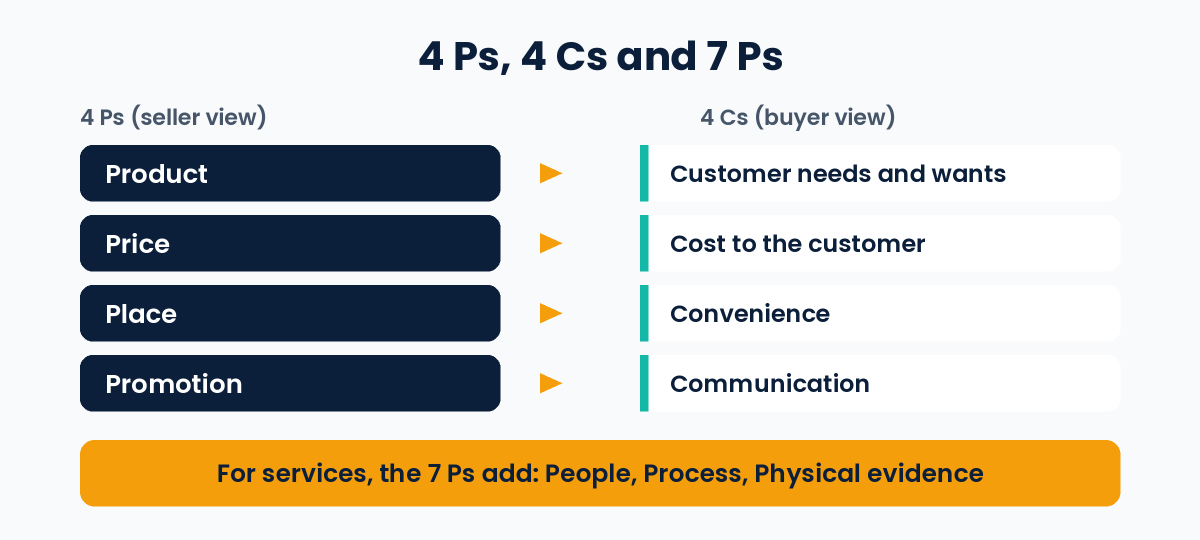
| 4 Cs | Robert Lauterborn, 1990 | Customer needs and wants, cost, convenience, communication | Looking at the same decisions from the buyer’s side |
| 7 Ps | Bernard Booms and Mary Jo Bitner, 1981 | The 4 Ps plus people, process and physical evidence | Service businesses |
The 4 Cs match the 4 Ps one to one: product becomes customer needs and wants, price becomes cost, place becomes convenience, and promotion becomes communication. They are not a replacement. They are a second way to check the same decisions.
A 10-Minute 4 Ps Check for Your Own Business
Answer each question in one sentence. If you cannot answer one, that is your next research task.
- Product: Which customer problem does it solve, in one sentence?
- Product: What do customers say they like or dislike about it? Check reviews, messages and returns.
- Product: What makes it different from the closest alternative?
- Price: What is your cost per sale, and how much profit is left at your current price? Our guide on performance marketing shows how to work out break-even numbers.
- Price: How does your price compare with the alternatives your customers really consider, and why?
- Place: Where do your customers already look for products like yours?
- Place: What is the easiest way to buy, and at which step do people give up?
- Promotion: Which one or two channels reach your customers today, and how do you know?
- Promotion: Is your message the same on your website, ads and social media?
- Fit: Do all four point the same way? A premium product, a bargain price and a hard-to-find shop would not.
Limits of the 4 Ps
- It is a checklist, not a strategy. It tells you what to decide, not what to choose.
- It starts from the seller’s side. It does not ask about customers by itself, which is one reason the 4 Cs were created.
- It was created in 1960, when most marketing was about physical goods. Services need extra thinking, which is why the 7 Ps exist.
- It does not replace research. You still need real information about your customers and competitors.
Common Mistakes to Avoid
- Filling in the four Ps without researching real customers
- Copying a competitor’s price without checking your own costs
- Spending most of the effort on promotion and ignoring the other three
- Changing one P without checking how it affects the others
- Never reviewing the mix after the first plan
Frequently Asked Questions
What are the 4 Ps of marketing?
The 4 Ps of marketing are product, price, place and promotion. They are the four main decisions a business makes when taking something to market.
Who created the 4 Ps of marketing?
E. Jerome McCarthy presented the 4 Ps in his 1960 textbook Basic Marketing: A Managerial Approach. He built on the earlier marketing mix idea popularized by Neil Borden.
What is the difference between the 4 Ps and the marketing mix?
The marketing mix is the broader idea: the set of elements a business controls to reach its customers. The 4 Ps are the most common version of it. Other versions exist, such as the 7 Ps for services.
Are the 4 Ps of marketing still relevant?
Yes, as a simple planning checklist. They are still widely taught and used. For services you may need the 7 Ps, and you should always combine the framework with real customer research.
What is the fifth P of marketing?
There is no single official fifth P. Many sources add people as the fifth P. For services, Booms and Bitner added three: people, process and physical evidence, which gives the 7 Ps. Some writers propose other Ps, so check which model a course or book is using.
Which of the 4 Ps is the most important?
No single P is the most important. They have to fit together. A good starting point is the product, because it should solve a real customer problem before you decide how to price, sell and promote it.
Conclusion
The 4 Ps of marketing give you a simple way to organize your thinking: what you sell, what it costs, where people can buy it, and how they hear about it. Use them as a checklist, back each decision with real customer information, and review all four together.
For the next step, learn how to measure your promotion in our guide on what is performance marketing, or read how AI search is changing visibility in our guide to generative engine optimization.
Sources and further reading:
- McCarthy, E. J. (1960). Basic Marketing: A Managerial Approach. Richard D. Irwin.
- Borden, N. H. (1964). “The Concept of the Marketing Mix.” Journal of Advertising Research.
- Booms, B. H., and Bitner, M. J. (1981). “Marketing Strategies and Organization Structures for Service Firms.” In Marketing of Services (pp. 47-52). American Marketing Association.
- Lauterborn, R. (1990). “New Marketing Litany: Four Ps Passé: C-Words Take Over.” Advertising Age, 61(41), 26.
- The Four Ps of Marketing (American Marketing Association)
- Marketing Mix (EBSCO Research Starters)
- Business details on Google Search (Google Search Central)
