
Last updated: November 4, 2026
If you are asking what is performance marketing, the short answer is this: it is a type of digital marketing where you pay based on measurable actions, such as a click, a lead, a sale or an app install, and judge every campaign by those results, not by how many people simply saw your ad.
In this guide, you will learn how performance marketing works, which channels and metrics matter, where it falls short, and how to get started. The language is simple and there is no hype.
Performance Marketing Meaning
Performance marketing is a results-based approach to online advertising. You set a clear goal, run campaigns, and pay based on actions that can be measured. In the purest form (affiliate programs and cost-per-sale deals), you pay only when the action happens. On ad platforms such as Google and Meta, you often pay per click or per impression, and then measure the results.
Examples of an “action”:
- A person clicks your ad
- A person fills in a form (a lead)
- A person buys a product
- A person installs your app
The key idea is measurability. Spend can usually be linked to results, so you can see what works and stop what does not. Tracking is never perfect, as the limitations section below explains.
How Performance Marketing Works
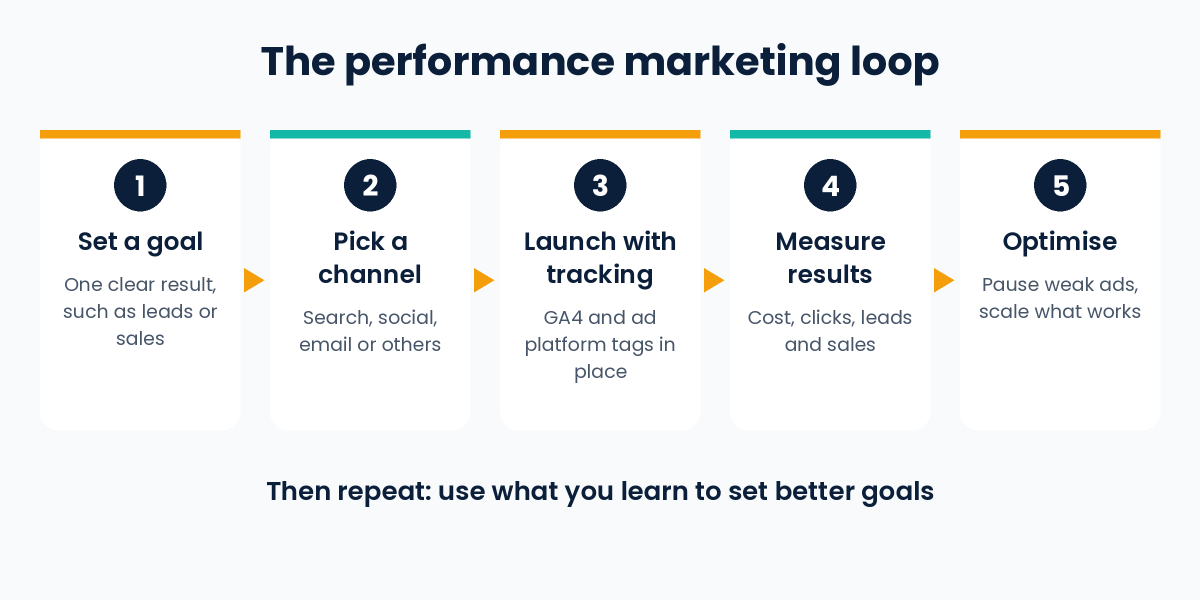
Most campaigns follow the same loop:
- Set a goal. For example, “get 100 enquiries this month at under ₹500 each.”
- Pick a channel. Choose where your audience spends time (search, social, email and so on).
- Launch ads with tracking. Install tracking tools such as Google Analytics 4 and the ad platform’s pixel or tag.
- Measure results. Check cost, clicks, leads and sales.
- Optimise. Pause weak ads, improve landing pages, test new creatives, and put more budget into what works.
This loop of test, measure and improve is the heart of the practice.
Common Payment Models
| Model | You pay for | Typical use |
|---|---|---|
| CPC (cost per click) | Each click on your ad | Search and social ads |
| CPL (cost per lead) | Each lead generated | Education, real estate, services |
| CPA / CPS (cost per acquisition / sale) | Each customer or sale | E-commerce, affiliate programs |
| CPI (cost per install) | Each app install | Mobile apps |
| CPM (cost per 1,000 impressions) | Every 1,000 views | Awareness-focused campaigns |
Note: some platforms charge per click or per impression even if your goal is a sale. The model you pay on and the result you want are not always the same, so check how each platform bills you.
Main Performance Marketing Channels
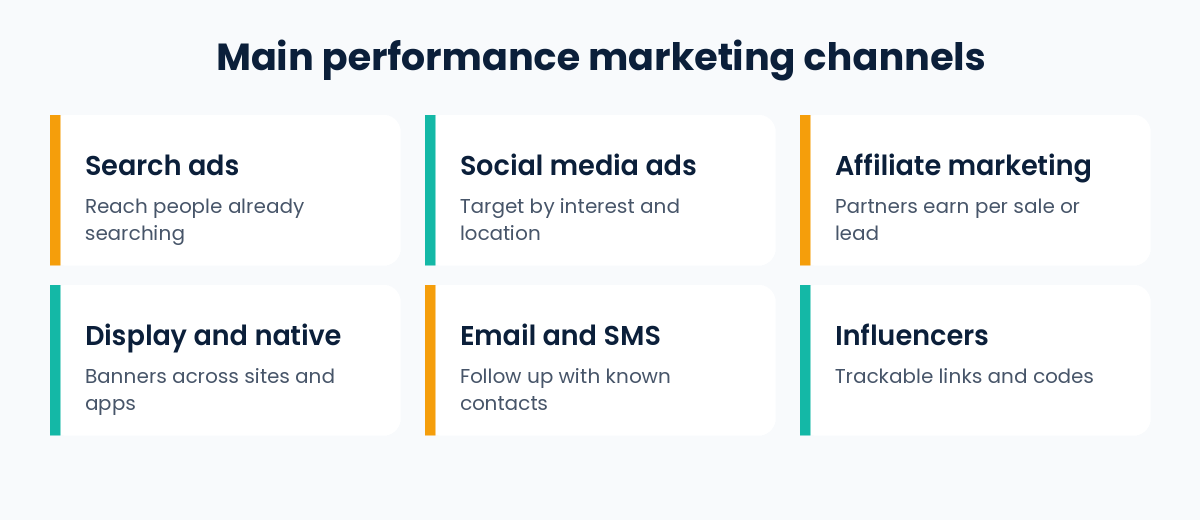
- Search ads (Google Ads): Reach people actively searching for what you offer.
- Social media ads (Meta, LinkedIn, YouTube and others): Reach people by interest, behaviour and location.
- Affiliate marketing: Partners promote your product and earn a commission per sale or lead.
- Display and native ads: Banner and content-style ads across websites and apps.
- Email and SMS marketing: Low-cost follow-up with people who already know you.
- Influencer marketing (when tied to trackable links or codes): Creators promote your offer and you measure results through unique links.
SEO and organic content are not paid performance channels, but they work well alongside them and can lower your long-term cost of getting customers.
Key Metrics to Track
- CTR (click-through rate): Clicks ÷ impressions. It shows how appealing your ad is.
- Conversion rate: Conversions ÷ visitors. It shows how well your landing page works.
- CPA / CPL: Total spend ÷ number of customers or leads.
- ROAS (return on ad spend): Revenue from ads ÷ ad spend.
- CAC (customer acquisition cost): Total cost of winning one customer, including all marketing costs.
- LTV (lifetime value): Total revenue you can expect from one customer over time.
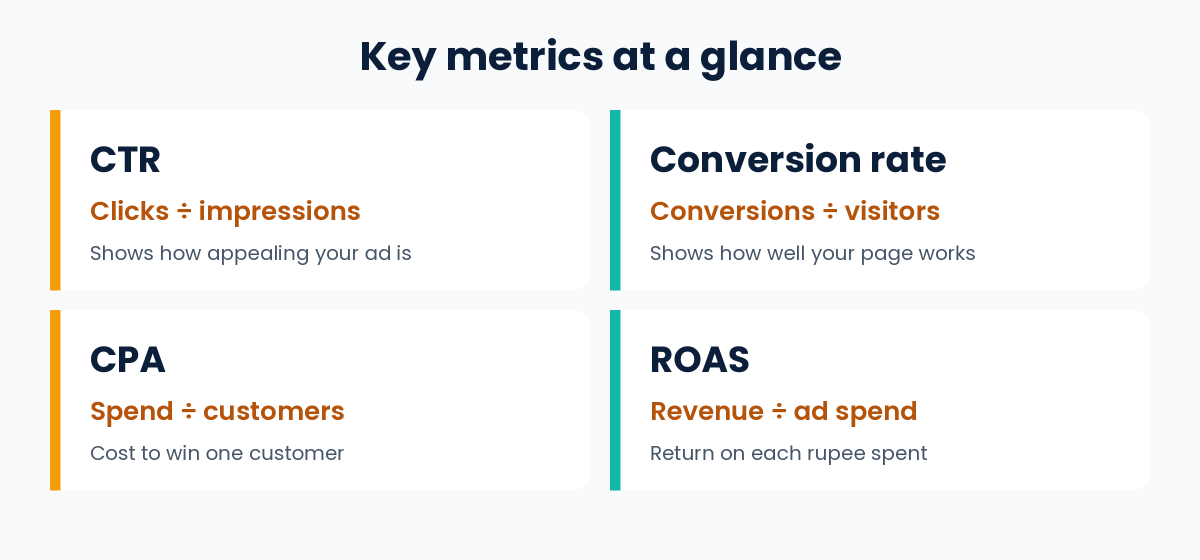
Simple example (illustrative numbers only): You spend ₹50,000 on ads and get 100 customers. Your CPA is ₹50,000 ÷ 100 = ₹500. If those customers bring ₹2,00,000 in revenue, your ROAS is ₹2,00,000 ÷ ₹50,000 = 4. That means ₹4 earned for every ₹1 spent. Whether that is good depends on your profit margin, not on the number alone.
Performance Marketing vs Brand Marketing
| Performance marketing | Brand marketing | |
|---|---|---|
| Main goal | Measurable actions (leads, sales) | Awareness and trust |
| Payment | Per click, lead, sale or install, depending on the deal | Usually for reach, time or placement (for example CPM or sponsorships) |
| Time to see results | Often quicker to see in the data | Often builds over a longer period |
| Measurement | Detailed and trackable | Harder to measure directly |
Neither is “better.” Brands that only do performance marketing can struggle when people do not recognise them, and brands that only do awareness may not know what drives sales. Most businesses need both.
Benefits and Limitations
Benefits
- You can see where your money goes
- You can start with a small budget and scale up
- You can test and improve quickly
- Targeting options are detailed
Limitations
- Costs can rise as competition increases
- Results stop when you stop paying for ads
- Tracking is not perfect, because privacy rules, ad blockers and cookie limits can hide some conversions
- Poor landing pages or weak offers waste budget, however good the ads are
Being honest about these limits will save you money.
How to Start Performance Marketing, Step by Step
- Define one clear goal. Leads, sales or installs, not “more traffic.”
- Know your numbers. Work out how much you can afford to pay per customer and still make a profit.
- Set up tracking first. Install GA4 and the ad platform tags, and test that conversions are recorded.
- Build a focused landing page. One offer, one action, fast loading, mobile friendly.
- Start on one channel. Google Search or Meta ads are common starting points.
- Run small tests. Try 2 to 3 ad variations and let them gather enough data before deciding.
- Review weekly. Cut what loses money, scale what works.
Know Your Break-Even Numbers Before You Spend
Before you run any ads, work out how much you can afford to pay for one result. These simple formulas help:
- Profit per sale before ads = selling price minus what it costs you to deliver the product (product cost, payment fees, delivery).
- Break-even CPA = profit per sale before ads. If you pay more than this to win one sale, you lose money on that sale.
- Break-even ROAS = 1 ÷ profit margin. With a 40% margin, 1 ÷ 0.40 = 2.5.
Worked example (made up): A product sells for ₹1,000 and costs ₹600 to deliver, so the profit before ads is ₹400 (a 40% margin). Break-even CPA is ₹400 and break-even ROAS is 2.5. Here is what each ₹1,000 of ad spend does at different ROAS levels:
| ROAS | Revenue from ₹1,000 ad spend | Profit before ads (40% margin) | Result after ad spend |
|---|---|---|---|
| 2.0 | ₹2,000 | ₹800 | Loss of ₹200 |
| 2.5 | ₹2,500 | ₹1,000 | Break-even (₹0) |
| 3.0 | ₹3,000 | ₹1,200 | Profit of ₹200 |
Notice that a ROAS that looks healthy can still lose money. At a 25% margin, break-even ROAS is 4. This example ignores repeat purchases and other costs such as staff and tools, so use it as a starting point, not a full profit model.
How to Diagnose a Weak Campaign
When results disappoint, check the journey from top to bottom. These are starting points, not proof of the cause.
| What you see | Check first |
|---|---|
| Few people click your ads | The ad message, the audience or keywords, and whether the offer is clear |
| Many clicks but few leads or sales | Whether the landing page matches the ad, mobile page speed, form length, and whether the traffic matches your real customer |
| Conversions, but the cost per result is too high | Targeting and keywords, whether the offer is priced right, and whether tracking counts the same sale twice |
| Strong numbers in the ad platform but weak real sales | Tracking setup, lead quality, and how quickly your team follows up |
| Results suddenly drop | Broken tracking, ad disapprovals, budget or billing problems, and seasonal or competitor changes |
Change one thing at a time, so you can tell what made the difference.
Common Mistakes to Avoid
- Launching ads before tracking works
- Judging an ad after only a day or two of data
- Looking at clicks while ignoring actual sales or leads
- Sending all traffic to a homepage instead of a dedicated landing page
- Copying a competitor’s strategy without checking your own numbers
Frequently Asked Questions
Is performance marketing the same as digital marketing?
No. Digital marketing is the broad field. Performance marketing is one part of it, focused on paid, measurable results.
Is performance marketing only for big companies?
No. You can start with a small daily budget, as long as you track results properly.
How much does performance marketing cost?
It depends on your industry, location, competition and platform. There is no fixed price. Set your budget based on how much you can afford to pay per customer.
Which is the best performance marketing channel?
There is no single best channel. It depends on where your audience is and what you sell. Test one or two before expanding.
What skills do I need to work in performance marketing?
Basic analytics, ad platform knowledge (Google Ads, Meta Ads), copywriting, landing page optimisation and comfort with numbers.
Conclusion
Performance marketing is about paying for results you can measure and improving them over time. It works best when you have a clear goal, proper tracking, a good offer and patience to test.
If you run Google Ads, our article on the core benefit of Google Ads automated bidding explains how Google can set bids for you toward the CPA or ROAS goal you choose.
If you want help running campaigns, see our Google Ads services, or read our beginner guide on what is SEO.
Sources and further reading:

4 thoughts on “What Is Performance Marketing? How It Works and How to Start”