
Last updated: November 4, 2026
Digital marketing can be a good career if you are willing to keep learning and can show real results. It is not an easy shortcut. Entry-level work is competitive, tools change quickly, and AI now handles many routine tasks.
This guide does not try to sell you a course. It helps you decide, with honest trade-offs, a salary reality check, and a 90-day test you can run before you commit.
The Short Answer: Who It Suits
It may suit you if you:
- Enjoy mixing creative work (writing, design, ideas) with numbers (clicks, costs, conversions)
- Like testing something, checking the result and trying again
- Are happy to keep learning as platforms and tools change
- Can explain what you did and what happened in simple words
Think twice if you:
- Want a stable, unchanging set of skills for the next 20 years
- Dislike being measured on results you only partly control
- Expect quick money without building proof of your work first
What Digital Marketers Actually Do
“Digital marketing” is a group of different jobs. Knowing which one you want is more useful than asking whether the whole field is good.
| Area | What you do | What you need to be good at |
|---|---|---|
| SEO | Help a website get found in search results | Research, writing, patience, basic technical checks |
| Paid ads (PPC) | Run and improve ad campaigns, for example on Google or Meta | Numbers, testing, budget discipline |
| Content marketing | Plan and create articles, videos and guides | Clear writing, research, original ideas |
| Social media | Build and manage a brand’s presence and community | Communication, trend awareness, consistency |
| Email and CRM | Send useful messages to customers and track the results | Organisation, segmentation, testing |
| Analytics | Measure what works and explain it | Spreadsheets, curiosity, clear explanation |
What Do Digital Marketers Earn in India?
Be careful with any single salary number, including the ones you see online. Salary data is mostly self-reported and changes fast.
- AmbitionBox, a site where employees share their salaries, showed a 2025 snapshot of about ₹1.2 to ₹5.4 lakh a year for digital marketing executives with up to five years of experience, based on roughly 37,600 reported salaries.
- A later version of the same page lists a higher range of about ₹2 to ₹7.8 lakh a year.
That is a wide gap, and it is normal. Pay depends on your city, the size and type of employer, your specialisation, and most of all your proof of results. Treat these figures as a rough guide, not a promise, and check current numbers on AmbitionBox, Glassdoor and real job posts for the role and city you want.
How AI Changes the Career
AI is changing the tasks more than it is removing the field. Tools can now draft copy, group keywords and adjust bids. Our guide on how AI affects digital marketing goes through this channel by channel.
For your career, three points matter:
- The World Economic Forum’s Future of Jobs Report 2025, based on a survey of employers worldwide, lists AI and big data among the fastest-growing skills through 2030, alongside creative thinking, resilience and lifelong learning.
- Routine beginner tasks, such as basic copywriting and routine reporting, are the ones AI tools handle best. That makes it harder to stand out with tool skills alone.
- Judgement is harder to automate: deciding who to reach, what to say, and whether a number can be trusted.
Do You Need a Degree?
Not always, but it depends on the employer. Some job posts list a graduate degree. Others focus on skills and proof of work. Before you decide, read ten job posts for the role you want and note what they ask for.
Free learning is available. Google’s Skillshop offers free Google Ads and Google Analytics certifications, and the Google SEO Starter Guide is free. A certificate shows you finished the training. It does not replace real project results.
A 90-Day Test Before You Commit
The best way to know if this career suits you is to try the work for a short time. This plan is my suggestion, not an official method.
- Weeks 1 to 2: learn the basics. Read what is SEO and our guide on what is performance marketing. Notice which one you find more interesting.
- Weeks 3 to 6: pick one area and run a small project. For example, publish a few helpful articles on a simple blog and track them in Google Search Console, or help a local shop with its Google Business Profile. If you try paid ads, use a small budget you can afford to lose, and set a daily cap.
- Weeks 7 to 10: measure and write it up. Make a one-page summary: what you did, what changed, and what you would do differently. Use real numbers, even if the result was small or negative.
- Weeks 11 to 12: test the market. Apply for ten roles or offer your help to two or three small businesses. Note the questions they ask.
How to read the result: if you enjoyed the weekly routine of checking numbers, learning from them and improving, that is a good sign. If you dreaded it, better to know now.
The Downsides, Honestly
- Constant change. Platforms update their rules and features often, so what you learn this year needs refreshing.
- You are judged on results. Clients and managers will look at the numbers, even when some factors are outside your control.
- Competition at the entry level. Many people apply for the same beginner roles, so proof of work matters.
- Uneven income if you freelance. Clients can come and go, so you need savings and a steady way to find work.
Frequently Asked Questions
Is digital marketing a good career for freshers?
It can be, if you build proof of your skills. Employers hiring freshers usually look for evidence that you can do the work, such as a small project, a portfolio or relevant certifications, not only for a certificate.
Do I need to know coding?
Usually not for entry-level roles. Comfort with spreadsheets and analytics tools helps a lot. Basic HTML can be useful for SEO and tracking, but check the requirements of the role you want.
Will AI take digital marketing jobs?
AI is changing the work and is likely to affect routine tasks most. Strategy, judgement and trust with clients are harder to automate. Learning to use AI tools well is part of the job now.
How long does it take to get a first job?
There is no reliable average. It depends on your skills, your proof of work, your city and the market. A real project and a clear portfolio shorten the search.
Is digital marketing stressful?
It can be, especially with deadlines and result targets. Agencies and client work can be fast-paced. Ask about workload, targets and training when you interview.
Which area should I start with?
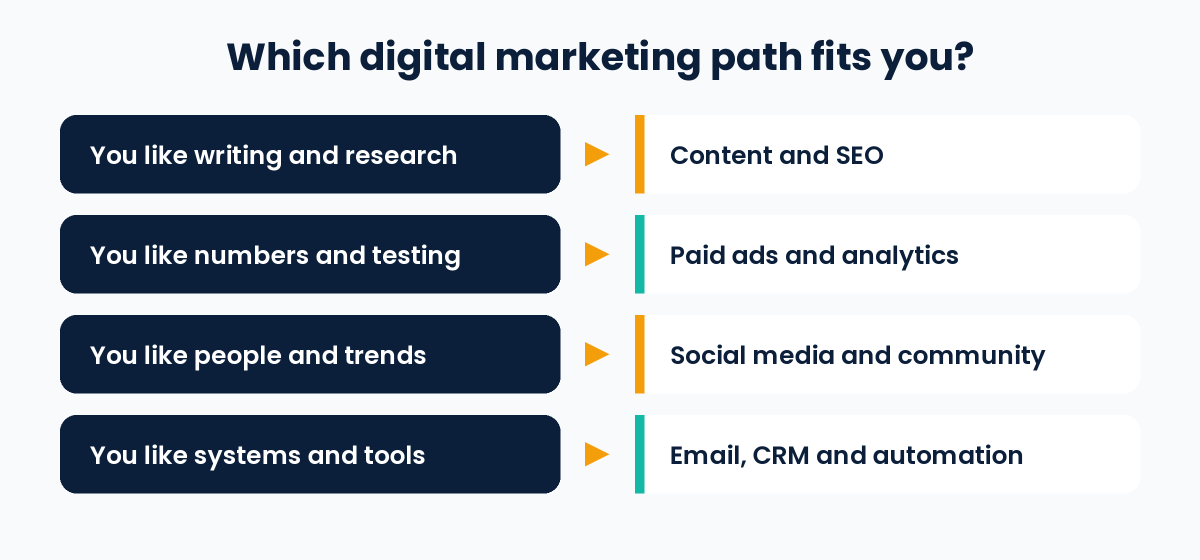
Pick the one that matches what you already enjoy: writing and research suit content and SEO, numbers and testing suit paid ads and analytics, and people and trends suit social media. You can change later.
Conclusion
Digital marketing is a good career for people who like learning, testing and explaining results, and who are willing to build proof before expecting pay. It is a poor fit for anyone looking for a quick, fixed path. Try the 90-day test, be honest about how it feels, and then decide.
Related Guides
- Is AI going to affect digital marketing?
- What is SEO: a plain-English guide for beginners
- What is performance marketing: definition, CPA and ROAS
Sources and further reading:
2 thoughts on “Is Digital Marketing a Good Career? An Honest 2026 Guide”